
Boxing Hand Wraps: Fight vs Training, and Do They Work? (NZ Guide for Martial Artists)
In a five-year study of Great Britain's elite amateur boxing squad, the hand was injured more often than any other part of the body, head included. A pair of hand wraps is the cheapest protection you can buy for it, yet plenty of people wind them on without knowing what the wrap is actually doing. This guide is for boxers, Muay Thai and MMA people around New Zealand who want the straight story: where wraps came from, what they can and can't do, and why a fighter's wraps on fight night look nothing like the pair in your gym bag.
The Short Version
Hand wraps keep your wrist straight and bind the small bones of your hand together under the glove. They're worth wearing for any bag, pad or sparring work, but they add almost no padding, and the case that they prevent injury rests on biomechanics and coaching experience rather than solid trials. Training wraps are reusable cloth you put on yourself; fight wraps are gauze and tape, applied by your coach in front of an official and cut off afterwards.
What a Hand Wrap Actually Is (and Why It Matters)
A hand wrap is a strip of cotton or stretch cotton, usually 2.5 to 4.5 metres long, wound around the wrist, across the knuckles and around the thumb before the glove goes on. Your hand has 27 bones, and a hard punch tries to push them in different directions at once. The wrap makes that bundle behave more like one solid unit and stops the wrist folding on impact.
The idea is very old. Ancient Greek boxers bound their hands and wrists with leather straps called himantes, leaving the fingers free, and some accounts put those straps at roughly three to three and a half metres long. That's close to a modern adult wrap. In Thailand, fighters wrapped their hands and forearms in hemp rope (Muay Kard Chuek), with knots over the knuckles that protected the hand and did real damage to the other bloke. Gloves became compulsory there after a death in the ring, usually dated to 1929, and the rope now turns up mostly at cultural and traditional events. Once padded gloves took over, the wrap stopped being part of the weapon. Its only job now is keeping your own hand intact inside the glove.
Here's where most people's picture of wraps goes wrong. A standard cloth wrap is only a few layers of thin fabric, so it adds very little cushioning, and the padding comes from your glove. Holding the wrist straight is the part fighters, coaches and physios agree on most. Whether wraps cut down on broken hands is less certain: we couldn't find a controlled trial comparing injury rates with and without them. The case rests on how the hand is built, on injury patterns, and on generations of coaches seeing what goes wrong without them. For padded and gel wraps the evidence is thinner still. One study of six athletes found gel-reinforced wraps lowered the force measured at the knuckles, which is promising but a long way from proof.
Wrapping for training and wrapping for a fight are two different jobs. In the gym you wind on your own cloth wrap, close the Velcro and you're away, and afterwards it goes through the wash for next time. For a professional bout, your coach builds the wrap from soft gauze and surgical tape, moulds it tight to your hand with extra gauze over the knuckles, and an official watches and signs it before the gloves go on. After the fight it's cut off and binned.
Those fight wraps are tightly regulated. A typical US commission allows no more than 15 yards of 2-inch gauze and 10 feet of 1-inch tape per hand, and the tape can't sit within an inch of the knuckles when the fist is clenched. Amateur boxing is often stricter: older international amateur rules allowed a single crepe bandage of no more than 2.5 metres and banned tape over the knuckles. The checks exist because people have cheated. In 2009, before Antonio Margarito fought Shane Mosley in Los Angeles, inspectors found knuckle pads in Margarito's wraps that had been hardened with a plaster-like substance, and the California commission revoked his licence.
New Zealand has no single national athletic commission. Under the Boxing and Wrestling Act 1981, boxing contests need a police permit and must run under an approved association's rules, so what's allowed under your gloves depends on who is sanctioning the event.
- Keeps the wrist straight, so it's less likely to sprain when a punch lands at a bad angle.
- Squeezes the knuckles and the long bones of the hand together, which probably spreads the load more evenly across them.
- Soaks up sweat, so your gloves last longer and get less rank.
- Cuts off circulation if it's too tight, and gives false confidence if it's too loose.
- Can't save a bent wrist or a punch that lands on the small knuckles. Only technique fixes those.
What to Look For
Size and Fit
Length is the main decision. A 2.5 m wrap suits kids and small hands. At 3.5 m (about 120 inches) you get the essentials with less bulk, which some people with small hands or snug gloves prefer. For most adults we'd point you to 4.5 m (about 180 inches), because it leaves enough for proper turns around the wrist as well as the knuckles. Once you're wrapped, your hand should still slide into your gloves easily. If your 14 oz sparring gloves suddenly feel a size too small, you've used too much wrap. The mistake we see most is someone with small hands buying 4.5 m wraps and ending up with a lump of fabric in the palm that stops a proper fist.
Materials and Build
Traditional cotton wraps have no stretch. They last well and feel locked in, but it takes practice to get them on smooth and flat. Semi-elastic wraps (often called Mexican-style) give a little, mould to the hand and are far easier for beginners to get right, which is why you see them in most Kiwi boxing and Muay Thai gyms. Gel or slip-on quick wraps are fast, but they give much less wrist support than a proper wrap. They're fine for a fitness boxing class and not what we'd want under gloves for hard bag work or sparring. Check the thumb loop and the Velcro tab, because cheap Velcro is usually the first thing to fail. Leave a damp pair balled up in your bag over an Auckland summer weekend and you'll smell them before you open the zip. Wash them in a mesh laundry bag on a cool cycle and hang them out until they're bone dry. New coloured wraps can run in the first wash, so keep them away from your white rash guard.
Safety and Comfort
A well-wrapped hand feels firm and supported, and you can still make a normal fist. Tingling, numbness, cold or pale fingertips, or a throbbing ache in the first round all mean the wrap is too tight, so take it off and start again. If you've hurt a knuckle or wrist before, get a physio to show you how to wrap or tape around it. A wrap isn't a treatment for an injured hand. ACC can help with treatment costs for sports injuries in New Zealand, so don't train through a sore hand for weeks hoping it settles.
How to Wrap Your Hands, Step by Step
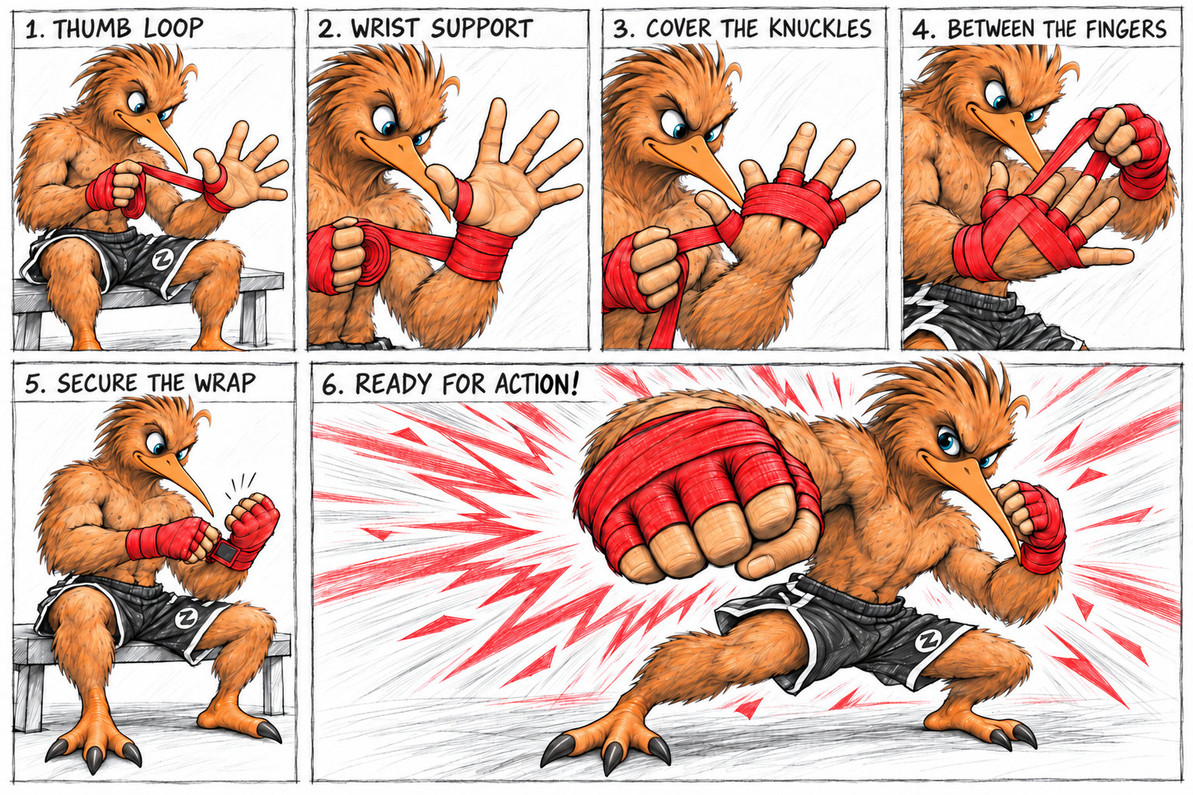
- Thumb through the loop – Most wraps have a "this side down" marking that goes against your skin. Spread your fingers wide and keep the hand relaxed.
- Wrist first – Do three or four turns around the wrist, moving slightly up the forearm. Keep it firm and flat, because this is the part that matters most.
- Across to the knuckles – Bring the wrap over the back of the hand and go around the knuckles three or four times, with your fingers still spread.
- Between the fingers (optional) – Come back from the wrist and take the wrap between each pair of fingers. This stops the knuckle layers sliding around.
- Lock the thumb – One turn around the base of the thumb gives it some support. Thumb ligament injuries are common in boxing.
- Finish on the wrist – Use up whatever length is left around the wrist and close the Velcro.
- Fist test – Clench hard and open your hand a few times. If anything pinches or your fingertips change colour, unwind it and go again. Your coach may teach a different pattern, and that's fine. The wrist and the knuckles are still the priorities.
What We'd Recommend
We stock stretch cotton wraps in a few lengths because they suit how most people in NZ gyms train. Two decent pairs you rotate and wash will do you more good than one expensive pair that never leaves your bag.
Just Starting Out
- Punch Urban Stretch Hand Wraps (4.5 m) – Semi-elastic and forgiving, so it's easy to get a smooth wrap while you're still learning. Good under gloves for boxing, Muay Thai or MMA bag work.
- We currently don't stock shorter 2.5 m wraps which are good for kids and smaller people at the moment so you could consider cutting a longer wrap in half to get two wraps.
Training a Few Times a Week
- Punch Urban Stretch Hand Wraps (4.5 m) – Semi-elastic and forgiving, so it's easy to get a smooth wrap while you're still learning. Good under gloves for boxing, Muay Thai or MMA bag work.
- Punch Mexican Gel Knuckle Protector – If your knuckles ache after a long session on the heavy bag, or you hit pads in thin bag mitts, this puts some padding where a cloth wrap can't. It's a 10 mm gel block in a cotton and elastic sleeve that slips over your knuckles before you wrap, and you wrap over the top as normal. It comes as a pair, in one size, and it's light enough that you stop noticing it once your gloves are on. It does add a bit of bulk, so try your gloves on over it before a session. Treat it as an extra for training, not a substitute for wrist support. The research on gel under wraps is encouraging but small (one study had six athletes), and fight rules generally allow only gauze and tape under the glove.
Competing or Training Hard
- Gauze – Lets your coach practise a gauze-and-tape fight wrap at training before fight night. Check the sanctioning body's limits first.
- Drago Roller Dual Hand Wrap Roller – Rolling two 4.5 m wraps by hand after training is the job most people rush, which is how they end up in a knot at the bottom of the bag. The Drago rolls both wraps at the same time with a small hand crank, and it clips over a door so the wraps can hang and dry before you roll them. In Auckland, that drying clip is the part we'd value most, because a wrap rolled up damp starts to smell within a day or two. It also comes with a mesh wash bag, which fits the cool-wash routine we suggest above. The maker says it rolls a pair in under 30 seconds and works with any brand or length of wrap. It's a nice-to-have rather than an essential, but if you're washing wraps several times a week it makes the routine a lot less fiddly.
Have a look at the full range in our Hand & Finger Protection collection.
Mistakes We See All the Time
- Wrapping with a clenched fist – The wrap tightens as soon as you open your hand, and by round two your fingers are numb. Wrap with your fingers spread.
- Piling it all on the knuckles – A fat pad over the knuckles feels protective, but if there are only two loose turns around the wrist you've missed the main job.
- Expecting the wrap to fix a bad punch – A bent wrist or a fist that lands on the little knuckles will still get hurt with wraps on. A coach watching your punch on the bag will protect your hands more than any extra layer of cotton.
- Leaving them in the bag – Damp cotton in a closed bag is a breeding ground for bacteria and fungus. When they're dry, roll them up from the Velcro end so the thumb loop sits on the outside, ready for next time.
Hand Wraps: Questions We Get Asked
My gloves are good quality. Do I still need wraps?
For bag work, pads and sparring, yes. Gloves cushion the outside of your fist, but they don't stop the bones inside shifting or your wrist bending, and that's what wraps are for. If all you do is a light cardio boxing class, you can get away with quick wraps or gloves alone, but proper wraps are the better habit.
Is there a difference between wrapping for a fight and wrapping for training?
A big one. Training wraps are cloth you put on yourself and reuse. Fight wraps are usually gauze and tape built by your coach, checked and signed by an official, then cut off after the bout, and there are strict limits on how much gauze and tape you can use.
Are gel or padded wraps better than normal ones?
There's some early evidence that gel-reinforced wraps reduce force at the knuckles, but it comes from very small studies. Slip-on gel wraps also usually support the wrist less than a proper wrap. If you like the feel of a gel product, wear it over a real wrap or keep it for lighter sessions.
My kid's just started boxing in NZ. What wraps do they need?
Get them 2.5 m wraps so there isn't extra fabric bunching inside small gloves, and check the wrap yourself until they can tell when it's too tight. If they start competing, ask the club which bandages are allowed, because amateur events can be stricter than the gym.
7. The Long and Short of It
The wrap's real job is keeping your wrist straight and the hand together, and that only works if it's wrapped with your fingers spread and plenty of turns on the wrist. Next session, wrap as usual, then do the fist test from step 7 and count your wrist turns. If there are fewer than three, there's your fix.
If you're stepping into the ring or cage here, get your sanctioning body's wrap rules in writing a few weeks out. Then have your coach practise a full gauze-and-tape wrap at training, so fight night isn't the first time you've felt one.
Ready for the next step? Check out our Hand & Finger Protection or read our Beginner's Guide to Martial Arts Protective Gear.
References
- Loosemore M, Lightfoot J, Palmer-Green D, et al. (2015). Boxing injury epidemiology in the Great Britain team: a 5-year surveillance study of medically diagnosed injury incidence and outcome. British Journal of Sports Medicine, 49(17), 1100–1107. bjsm.bmj.com/content/49/17/1100
- Loosemore M, Beardsley C, Lallemand B. (2016). Hand injuries in boxing. Aspetar Sports Medicine Journal, 5(1). journal.aspetar.com
- Gusnowski EM. Determination of the Protective Capacity of Hand Wraps in Combat Athletes Using Force Analysis. University of Western Ontario, Electronic Thesis and Dissertation Repository. ir.lib.uwo.ca/etd/8894
- Enhanced boxing punch impact with silicone cushioning (2024). Frontiers in Sports and Active Living. frontiersin.org
- Ancient Greek boxing. Wikipedia. en.wikipedia.org/wiki/Ancient_Greek_boxing
- Muay Thai: History. Wikipedia. en.wikipedia.org/wiki/Muay_Thai
- Kard Chuek: Muay Thai Ropes. Muay Thai Citizen. muaythaicitizen.com
- Wisconsin Administrative Code SPS 192.37, hand wraps (example of US commission gauze and tape limits). docs.legis.wisconsin.gov
- AIBA Rules for International Competitions, Rule III: Bandages (historical amateur rules). websites.mygameday.app
- Margarito v. California State Athletic Commission, California Court of Appeal. caselaw.findlaw.com
- Boxing and Wrestling Act 1981 (New Zealand). legislation.govt.nz
Recent Posts
-

Best Martial Arts for Women: How to Choose One (NZ Guide for Martial Artists)
Ask a few friends which martial art you should start with and you'll get conflicting advice, because …14th Oct 2026 -
Boxing Hand Wraps: Fight vs Training, and Do They Work? (NZ Guide for Martial Artists)
In a five-year study of Great Britain's elite amateur boxing squad, the hand was injured more often …14th Oct 2026 -

Judo Gi NZ Guide: How to Choose the Best Judo Uniform in New Zealand
Choosing the right judo gi in NZ is essential for safety, comfort and performance on the mat. A qual …14th Oct 2026