Karate Black Belt: How Long It Takes and How to Get There (NZ Guide for Martial Artists)
A karate black belt usually takes years of steady training. Practical advice on consistency, grading preparation and mindset to help you get there.
Most karate students start asking how long black belt takes somewhere around orange or green belt, usually straight after a grading. For most adults training steadily in a New Zealand club, the realistic answer is three to five years. This guide is for students already on the mat who want to get there without stalling at brown belt. It covers what graders look for, how to train between classes, and the gi and gear that will last the distance.
The Short Version
Plan on three to five years of training two or three times a week, but your style and organisation set the real minimums, so ask your instructor for them. Turn up consistently, learn your syllabus a grade ahead, practise for a few minutes at home most days, and let your sensei decide when you're ready.
What a Karate Black Belt Actually Is (and Why It Matters)
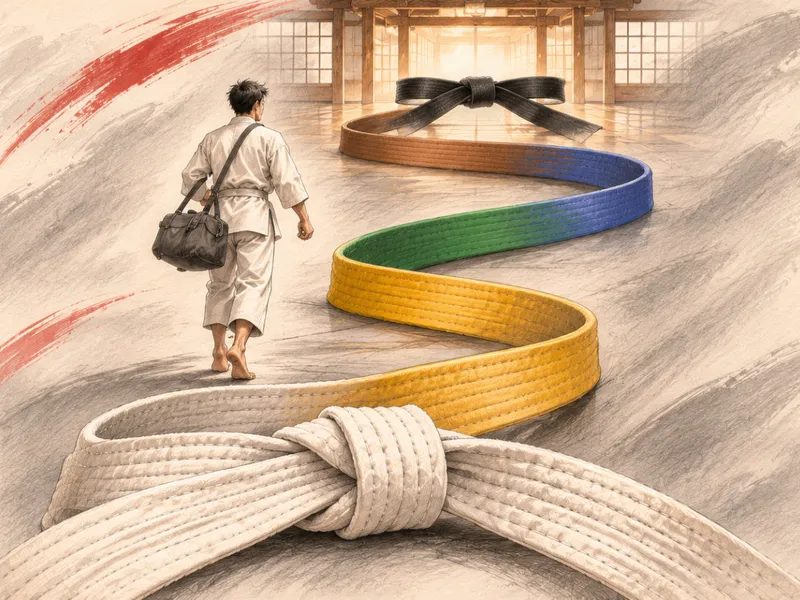
A first black belt is called shodan, which translates roughly as "first step". Kyu grades count down towards it (10th kyu is a fresh white belt, 1st kyu is the last brown belt), and dan grades count up from it. Plenty of senior instructors will tell you shodan means you finally have the basics in good order. It's a starting line for the deeper stuff, not a finish line.
There's no single national black belt standard. Karate New Zealand is the recognised national body and is affiliated to the World Karate Federation, but each style and organisation writes its own syllabus and timeframes. Some, like GKR, add a provisional black belt (shodan-ho) before full shodan. Others set minimum periods at each grade and an attendance requirement. That's why two people training the same number of years can be at different grades.
- A clear goal gives you a reason to turn up on cold, wet July nights when motivation is low.
- A black belt from one organisation doesn't automatically carry across to another. If you change styles, expect to re-grade or wear a lower belt for a while.
- Dan gradings are usually examined by senior graders from outside your dojo, and they look harder at basics than kyu examiners do. Gaps you skated over at green belt tend to show up here.
- If the belt is the only reason you train, there's nothing pulling you back to class the week after you get it.
What to Look For
Size and Fit
By the time you're grading for black belt, you'll be judged partly on how you present. Most graders like jacket sleeves finishing around the wrist bone and pants ending at or just above the ankle, so nothing catches on your hands or feet during kata. A gi that rides up every time you kick looks sloppy and pulls your attention away from your technique.
Cotton gis shrink, mainly in length, and the first hot wash does the most damage. If you're buying 100% cotton, go up a size or check the brand's size chart against your height, then wash it cold and hang it to dry. Poly-cotton blends hold their size far better. The belt should sit at your hips, tied with the two ends roughly equal. Some clubs have their own rule on belt length, so check before your grading.
Materials and Build
Gi weight is measured in ounces, and it changes how the uniform feels and behaves. An 8oz poly-cotton gi is light, cool and dries overnight, which suits beginners, kids and anyone training hard through an Auckland summer. A 10oz cotton gi is a solid middle ground for regular training. The 12oz to 14oz canvas kata gis give that crisp snap on every technique that graders and kata judges notice, but they're heavy, hot in a packed dojo and slow to dry in a damp winter.
Plenty of brown belts end up with two gis: a lighter one for weekly training and a heavyweight one kept for gradings and kata. What kills any gi faster than training is storage. A damp uniform zipped into a gym bag overnight starts to smell within a day and can mildew in humid weather. Get it out, hang it up, and wash it after every session.
Safety and Comfort
The biggest injury risk on the road to black belt is usually load, not a single bad moment. People often jump from two classes a week to four or five as a grading approaches, and knees, hips and lower backs complain about all those extra hours in low stances. Build up gradually over a few months instead.
For kumite, wear the hand mitts your club requires and a fitted mouthguard every time you spar. A pain that's still there after a week, or a joint that swells, is a reason to see a physio, not to train through it. Sport injuries in New Zealand are generally covered by ACC, so a physio visit can usually be lodged as a claim. If you take a knock to the head, stop training for the day and get it checked.
How to Get to Black Belt, Step by Step
- Get your syllabus – Ask your instructor for the full grading syllabus up to shodan, not just the next belt. Learn what's needed for your next grade properly, and start reading the one after it.
- Find out the real timeline – Ask what the minimum time at each grade is and whether there's an attendance requirement. Some organisations require a full year at 1st kyu, or a set number of classes, before you can attempt black belt.
- Lock in your class nights – Treat two sessions a week as fixed, like a work meeting. Books and videos are handy for revision, but only an instructor watching you can fix your stance.
- Practise little and often at home – Fifteen to twenty minutes most days beats one long session on Sunday. Research on spaced practice generally favours shorter sessions spread over more days for learning motor skills, though the evidence for complex skills like kata is thinner.
- Film yourself – Prop your phone up and record your kata once a week. You'll spot a dropped guard or a raised heel on video that you can't feel while you're doing it.
- Spar as well as do kata – Black belt gradings usually test kihon, kata and kumite. Students who love one tend to avoid the others, and examiners notice.
- Talk to the black belts in your club – Ask what caught them out at their dan grading. Most are happy to tell you, and their answers are usually more specific than anything you'll read online.
- Pair up with someone at your level – A training partner chasing the same grade gets you to class on nights you'd skip and keeps you honest on home practice.
- Expect a flat patch and keep turning up – Brown belt is where many people stall, because the syllabus gets longer and progress stops feeling obvious. That's normal. Students who keep showing up through it are the ones who grade.
What We'd Recommend
We stock karate gis across the weight range because the right one changes as you go up the grades. Most people don't need a heavyweight gi until brown belt.
Just Starting Out
- Dragon 8oz Karate Uniform – An entry-level lightweight gi, comes with a white belt, and does the job for the first few kyu grades without a big outlay.
- CORE Karate Gi Blue Label 8oz (White) – A tight-weave poly-cotton gi that holds its shape and size wash after wash. A sensible pick for kids who are growing fast, or adults training through summer.
Training a Few Times a Week
- CORE 2.0 Premium Karate Gi – 10oz, 100% cotton, soft and breathable. Heavy enough to look sharp at a grading but still comfortable for regular classes.
- CORE Kumite Hand Mitts – Padded knuckle protection for club sparring, in white, red and blue. Check which colour and style your club uses.
Competing or Training Hard
- Yamasaki 14oz Elite Karate Kata Gi – 14oz brushed cotton canvas with a Japanese cut. A good choice for brown belts preparing for a dan grading, where crisp presentation counts.
- CORE 2.0 Premium Karate Gi – 10oz, 100% cotton, soft and breathable. Heavy enough to look sharp at a grading but still comfortable for regular classes.
Have a look at the full range in our Karate Gis collection.
Mistakes We See All the Time
- Buying a 14oz gi at white belt – It's stiff, hot and slow to dry, and many beginners give up on it after a few weeks. Save the heavyweight gi for when you're closer to dan grading.
- Rushing towards the next grading – Pushing to grade the minute you're eligible leaves gaps that dan examiners pick up. A few extra months at a grade costs you little.
- Only training what you enjoy – Kata lovers who dodge kumite, and fighters who rush their kata, both struggle at black belt level because all of it gets tested.
- Training through a sore joint – Niggly knees and shoulders tend to get worse with more stance work, not better. See a physio early instead of losing three months later.
- Hot-washing a new cotton gi – We see this a lot with cotton gis. One hot wash and the pants end up well above the ankle. Cold wash, line dry.
- Buying your black belt in advance – In many clubs the belt is presented at the grading, sometimes by your instructor. Check with your club before ordering one.
Karate Black Belt: Questions We Get Asked
How long does it take to get a black belt in karate in NZ?
For most adults training two or three times a week, it's somewhere around three to five years. Some organisations take longer, and many students take a break along the way, which stretches it out. Your instructor can give you a far better estimate than any website, because they know your syllabus and how you're tracking.
Can I get a karate black belt faster by training more?
Up to a point. Training more often does help, but most organisations set minimum times at each grade that you can't skip, and a grader can tell when someone's crammed. Steady training over the full period gets better results than a sprint before the grading.
Can kids get a black belt in New Zealand?
Yes, but the rules vary by organisation. Some award a junior black belt with a re-grade later, some have minimum ages for full shodan, and some don't. If your child is getting close, ask the club what their policy is so nobody's caught off guard on the day.
Am I too old to go for black belt in my 40s or 50s?
No. Plenty of people grade to shodan later in life, and some styles suit older bodies better than others. Expect to need more recovery time between hard sessions and to work around old injuries, so have a frank chat with your instructor about what you can and can't do.
The Long and Short of It
Black belt mostly comes down to two things: turning up week after week, and knowing exactly what your syllabus asks of you. Talent helps, but students who train steadily for years and practise at home tend to grade, and those who drift in and out tend not to.
This week, ask your instructor for the full syllabus up to shodan and the minimum time at each grade, then pencil a realistic target date into your calendar. If your gi is already tight at the ankles or worn through at the knees, sort that out before your next grading, not the night before.
Ready for the next step? Check out our Karate gear or read Tips to Help You Improve Your Kata.
References
- Karate New Zealand. About Us. https://www.karatenz.co.nz/ABOUTUS1
- Karate New Zealand. Karate New Zealand Celebrates 50 Years. https://www.karatenz.co.nz/newsarticle/144196
- GKR Karate. Grading Requirements for Shodan-Ho. https://www.gkrkarate.com/?p=1218
- GKR Karate. Grading Requirements for Shodan 1st Dan Black Belt. https://www.gkrkarate.com/about-gkr/black-belt-shodan-ho/grading-requirements-for-shodan-1st-dan-black-belt/
- Ashihara Karate International. Grading Time Limits. https://www.ashiharakarate.org/?p=429
- Japan Karate Association. [New Zealand] Shodan Grading (2019). https://www.jka.or.jp/?p=18542
- Donovan, J. J., & Radosevich, D. J. (1999). A meta-analytic review of the distribution of practice effect. Journal of Applied Psychology, 84(5), 795–805.
- Smith, C. D., & Scarf, D. (2017). Spacing repetitions over long timescales: A review and a reconsolidation explanation. Frontiers in Psychology, 8, 962. https://pmc.ncbi.nlm.nih.gov/articles/PMC5476736/
- ACC (Accident Compensation Corporation). https://www.acc.co.nz