
Martial Arts Grading: History, Purpose and the Great Belt Debate
Where martial arts belts came from, what a grade should actually tell you, why grading causes so many arguments, and how to tell whether a club's grading system is fair. A plain-English guide for NZ beginners, parents and instructors.
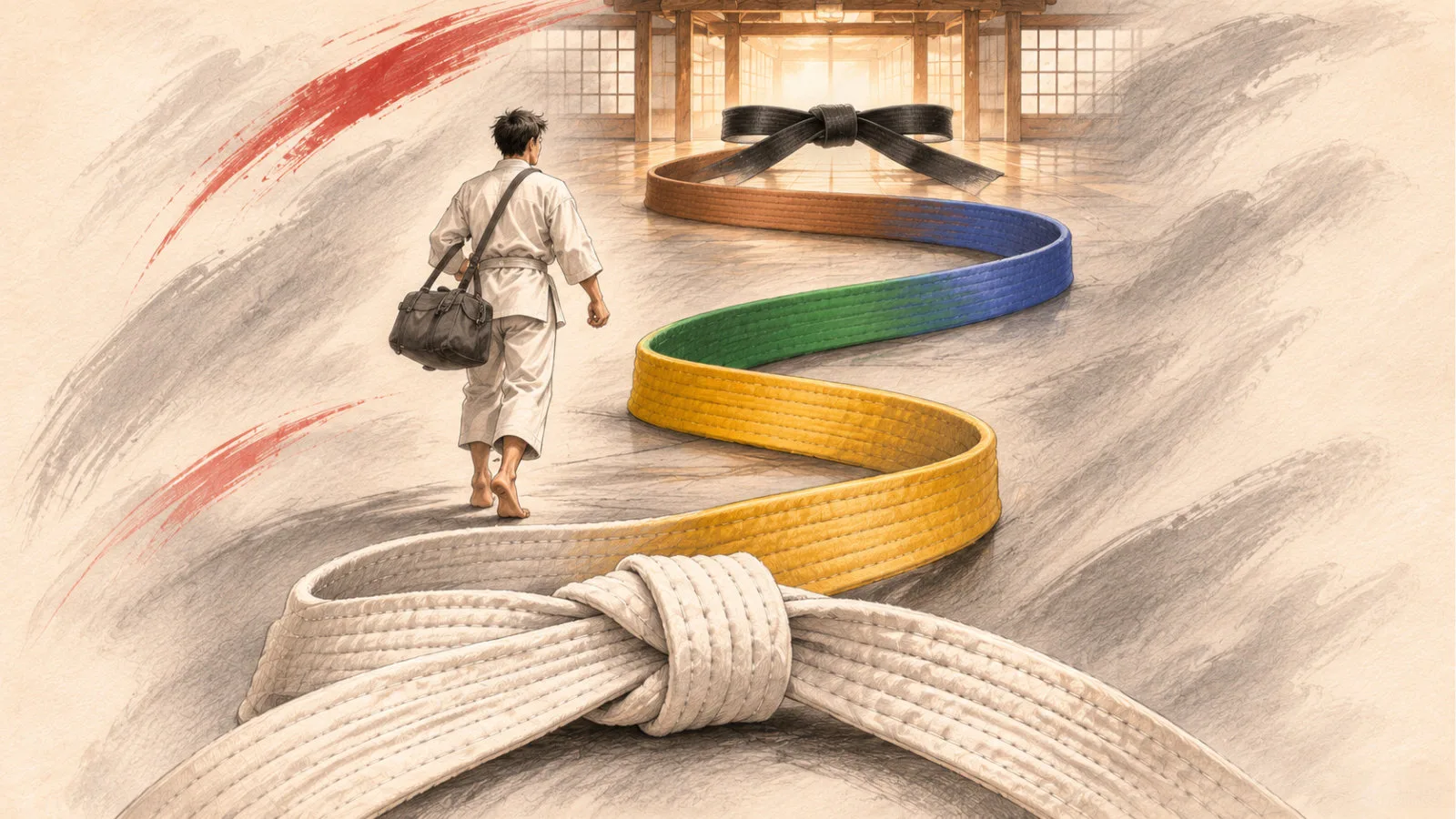
Belts are one of the first things people notice about martial arts. Kids want the next colour, parents wonder what it all means, and adults starting out quietly do the maths on how long black belt might take. Then someone at the club mentions a gym down the road handing out black belts to eight-year-olds, and the arguments start.
This guide is about martial arts grading: where the belt system came from, what a grade should actually tell you, why it causes so much debate, and how clubs can reward progress without cheapening the belts that matter. It finishes with a checklist for judging whether a club's grading system is fair.
Where martial arts grading came from
Before belts, the older Japanese martial schools (koryu) used licences. A student might receive a kirigami, then a mokuroku (a "catalogue" of what they'd learned), then a menkyo, a licence that often meant they could teach. The highest was menkyo kaiden, a licence of full transmission: you'd been taught everything the school had.[1] These were rare, private and slow. There was no outward sign of rank, and no syllabus you could look up.
Jigoro Kano, who founded judo at the Kodokan in Tokyo, changed that. In August 1883 he awarded the grade of shodan (first dan) to two senior students, Tomita Tsunejiro and Saigo Shiro.[2] Students below dan level were ranked in kyu grades, and the dan grades counted upward from there. Black belts for dan grades followed within a few years, though even the official biography of Kano says the exact start date is unclear.[2] At first those were the wide sashes worn with a kimono. The jacket-and-belt judogi came later, and our post on the history of the dogi tells that part.
The coloured belts in between came later again. The International Judo Federation says coloured kyu belts were invented in England in the mid-1920s, at London's Budokwai club, which was using them by 1927.[3] Mikinosuke Kawaishi, often credited with inventing them, took the idea to France in 1935 and built a teaching system around it.[3] Some coloured belts were also in use at the Kodokan by 1923, so it's fair to say the idea grew in more than one place.[2]
Karate borrowed the system from judo. In April 1924 Gichin Funakoshi issued karate's first dan certificates in Tokyo.[4] Adopting kyu and dan grades and a judo-style uniform helped karate win recognition from Japan's martial arts authority of the time, the Dai Nippon Butoku Kai.[5] Early karate had only white, brown and black. The rainbow of colours most clubs use now arrived over the following decades. Taekwon-Do, developed in Korea in the 1950s, uses the same structure under different names: ten gup grades, then black belt degrees.[6]
What a grade should actually tell you
A belt is a short message about the person wearing it. In a well-run club, that message covers four things.
- Skill. You can perform the techniques for your grade with control, under some pressure, not just from memory.
- Knowledge. You understand what you're doing and why: the terms, the principles, the reasons behind a kata or a pattern.
- Time on the mat. Some things only come from hours of training, such as timing, calm under pressure and the ability to adjust.
- Character. How you train: turning up, looking after partners, controlling contact, helping newer students. In karate this ties back to the values in the dojo kun.
What a belt doesn't tell you is whether someone can handle a real fight. Grading tests the syllabus. A street confrontation, or a hard round with someone who doesn't follow the rules, tests something else. Plenty of skilled black belts would struggle, and plenty of people with no belt at all can look after themselves. We'd rather say that plainly than promise something a belt can't deliver.
How grading differs between arts
There's no single system, even within one art. These are the broad patterns you'll meet in New Zealand.
Karate
Usually 8 to 10 coloured kyu grades, then dan grades. There's no single national standard. Each style or organisation sets its own syllabus, colours and minimum times, and gradings test kihon (basics), kata and kumite (sparring). If black belt is your goal, our karate black belt guide covers how long it realistically takes and what graders look for.
Judo
Judo New Zealand's syllabus uses kyu grades from white through yellow, orange, green and blue to brown, then dan grades.[7] Many clubs add tabs or half-colour belts between full grades, and some use junior "mon" grades shown as stripes.[7][8] Gradings test throws, holds and terminology, and competition results can count at higher levels.
Taekwon-Do
ITF-style Taekwon-Do uses ten gup grades from white to red with a black tip, with stripes marking the half steps.[6] In NZ, the International Taekwon-Do Foundation runs national gradings with set syllabus handbooks, and its senior black belt gradings include a theory exam.[9] The colours carry meanings taught to students (white for the beginner, through to red for danger and control), but those are teaching aids, not the origin of the colours.
Brazilian jiu-jitsu
BJJ has five adult belts: white, blue, purple, brown and black. Under the IBJJF graduation system, you must be at least 16 for blue, 18 for brown and 19 for black. You also need at least two years at blue before purple, 18 months at purple and a year at brown.[10] Children under 16 have their own belts (grey, yellow, orange and green). Within each belt, up to four stripes show progress.[10] Most gyms have no formal test. Your coach decides when you're ready, mostly from how you roll. Those IBJJF times are minimums, and most people take much longer.
Muay Thai
Traditionally, there are no ranks in Thailand. Your record and your trainer's opinion are your rank. The armband (prajioud, sometimes spelt prang chiang) has spiritual and gym meaning rather than signalling a grade. Some gyms outside Thailand now use coloured armbands as grades. The Kru Muay Thai Association, registered in Thailand in 2003, runs a Khan grading system with coloured mongkol (headbands), but it's one association's system, not a Thai tradition.[11]
Boxing
No belts, and no ranks. Progress shows in your sparring, your coach's trust and, if you compete, your bout record. Some boxing bodies run skills award schemes with certificates. England Boxing's, for example, has three non-contact levels before any sparring.[12] The only belts in boxing are championship belts, and you win those in the ring.
Why grading is so controversial
Belts are meant to keep a standard. When they stop doing that, people notice. These are the complaints we hear most across the counter.
McDojos. The slang name for clubs that sell rank rather than teach it. Typical signs: everyone passes every grading, long contracts with the black belt "included", and grading on a fixed calendar regardless of readiness. Not every big or commercial club is a McDojo. Plenty run excellent programmes and charge fairly for it.
Belt inflation. More colours, more stripes, and gradings every couple of months. Frequent rewards can keep beginners motivated, which is useful. The risk is that each belt means less, and a black belt becomes the end of a payment plan rather than years of work.
Grading fees. Grading costs money: examiners' time, certificates, national registration and the belt itself. A fee isn't a red flag. Fees that are unclear, rise with every grade for no obvious reason, or come with pressure to grade before you're ready are a different matter.
Kids' black belts. This is the big one. A ten-year-old can learn a syllabus, but they can't have an adult's judgement, strength or control. Some arts deal with this by design. BJJ won't award an adult belt before 16, and judo uses junior grades. Others award junior or provisional black belts, which is fine when everyone understands it's a junior grade with a clear step up later.
Rank versus competence. Underneath all of it is the gap between what a belt says and what the person can do. A grading system earns respect when the two stay close.
Recognising progress without diluting the main grades
For instructors, the challenge is keeping students motivated, especially kids, without handing out the grades that matter too freely. Sport NZ's Balance is Better approach to youth sport puts the emphasis on fun, skill development and long-term involvement rather than early results, which fits grading well.[13] Some practical ways to do it:
- Stripes or tabs. Small markers between full grades show progress without moving the main belt. BJJ and many judo clubs already do this.
- Junior ranks with a clear path. A separate kids' grade system, with a defined point where juniors move to the adult grades or earn a junior black belt that upgrades later.
- Skill badges. Awards for specific things, such as a breakfall badge, a first kata or first competition, worn on the uniform or kept on a card.
- Attendance and attitude awards. Recognise effort, consistency and being a good training partner separately from technical grade. These are often the students who stay longest.
- Certificates. A certificate for each grading, or a club "passport" signed off as skills are learned, gives families something to keep without changing what the belt means.
How to judge a club's grading system
Whether you're choosing a club for yourself or your child, these questions will tell you a lot. Ask them before you sign up.
That last one matters most. Watch a class and look at the brown and black belts. If they move well, control their partners and help beginners, the grading system is probably doing its job. For more on choosing a club, see our guides to choosing the right martial art for you and choosing a martial art for your child.
Questions we get asked
Can I keep my belt if I change clubs or styles?
Within the same style and organisation, usually yes. Moving to a different style or organisation, many instructors will ask you to wear a lower belt, or your current one with no stripes, until they've seen you train. That's normal, and it isn't an insult.
Do I have to buy a new belt every grading?
In most belt systems, yes, though many clubs supply the belt as part of the grading fee. Ask first so you don't double up. Most beginner gis come with a white belt.
Is a junior black belt a real black belt?
It's a real achievement, and it means the child has learned the junior syllabus well. It isn't the same as an adult black belt, and good clubs are open about that and explain how juniors step up later.
Your next step
If you're new, don't worry about belts for the first few months. Turn up, learn the basics and ask your instructor how grading works at your club. If you're a parent, our post on martial arts for kids covers what to expect in the early months. When grading day comes, Zenjo stocks martial arts belts in the usual grade colours, plus karate and BJJ uniforms, and our online store delivers across NZ. If you're an instructor sorting out belts or junior awards for a whole club, get in touch and we'll talk it through.
References
- Kochokai. "Mokuroku and menkyo." kochokai.nl. https://www.kochokai.nl/mokuroku-%e7%9b%ae%e9%8c%b2-menkyo-%e5%85%8d%e8%a8%b1/?lang=en (accessed 16 November 2026).
- Martial History Team. "Martial Arts Ranks: Clarifying Origins, Colors, and the Father of Japanese Swimming." May 2020, quoting Kano Sensei Biographic Editorial Committee (ed. and trans. A. Bennett), Jigoro Kano and the Kodokan: An Innovative Response to Modernisation, 2009. https://martialhistoryteam.blogspot.com/2020/05/martial-arts-ranks-clarifying-origins.html (accessed 16 November 2026).
- International Judo Federation. "Judo culture: the belts" and "British judo." ijf.org. https://www.ijf.org/history/judo-culture/2250 and https://www.ijf.org/history/from-martial-art-to-olympic-sport/1129 (accessed 16 November 2026).
- Japan Karate Association. "Supreme Master Funakoshi Gichin." jka.or.jp. https://www.jka.or.jp/en/about-jka/supreme-master-funakoshi-gichin (accessed 16 November 2026).
- Caile, C. "Budo Belts and Ranks: The Forgotten Symbolism." FightingArts.com. https://fightingarts.com/budo-belts-and-ranks-the-forgotten-symbolism/ (accessed 16 November 2026).
- International Taekwon-Do Foundation of New Zealand. Techniques Handbook (2017 changes), coloured belt grading requirements. https://www.members.itkd.co.nz/reference/documents/technical/Technqiues Handbook 2017 Changes.pdf (accessed 16 November 2026).
- Kaizen Kwai Judo. "Teaching and grading syllabus" (follows the Judo New Zealand syllabus). https://sites.google.com/view/kodomo-dojo/kaizen-kai/teaching-and-grading-syllabus (accessed 16 November 2026).
- Wellington Judo Club. "2025 grading." wellingtonjudo.org.nz, December 2025. https://www.wellingtonjudo.org.nz/2025/12/19/2025-grading/ (accessed 16 November 2026).
- International Taekwon-Do Foundation of New Zealand. "Senior dan requirements 2024." https://members.itkd.co.nz/events/gradings/black-belts/senior-dan-requirements-2024.php (accessed 16 November 2026).
- International Brazilian Jiu-Jitsu Federation. General System of Graduation, October 2022. IBJJF General System of Graduation (PDF) (accessed 16 November 2026). ibjjf.com
- Kru Muaythai Association. "History" and "Structure." krumuaythai.or.th. https://krumuaythai.or.th/about/history (accessed 16 November 2026).
- England Boxing. Schools and community boxing awards. englandboxing.org. https://www.englandboxing.org/?p=51542 (accessed 16 November 2026).
- Sport New Zealand. "Balance is Better philosophy." sportnz.org.nz. https://sportnz.org.nz/resources/balance-is-better-philosophy/ (accessed 16 November 2026).